
What Is Narrow Fabric? Types, Uses and Products Made
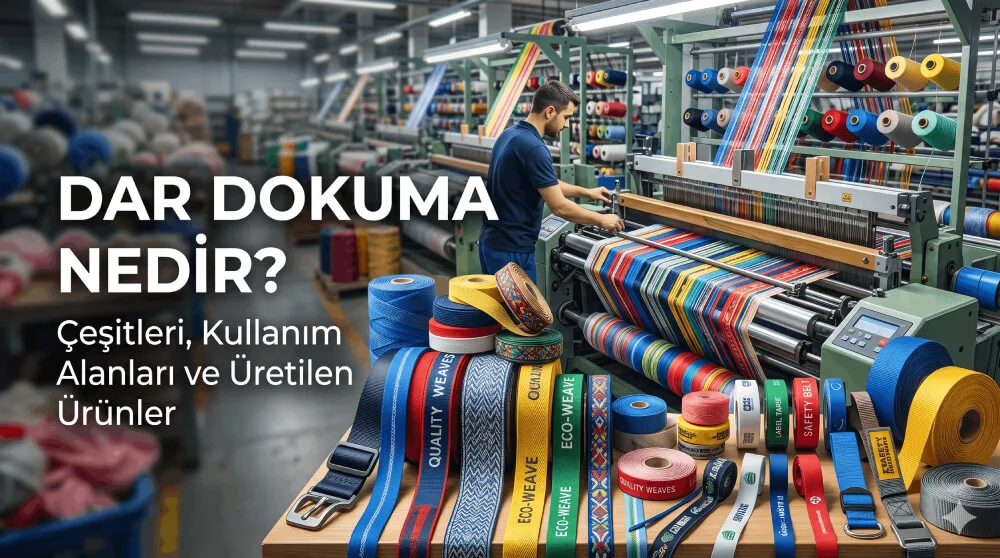
Narrow fabric is the collective name for tape, webbing, belts, ribbons and elastics woven up to 30 cm (12 inches) wide with finished edges on both sides. From seat belts to shoelaces, from orthopedic supports to cargo straps, this method sits at the core of countless everyday and high-performance products. In this guide we cover what narrow fabric is, its types, uses and how it is produced—shaped by our hands-on experience in the field.
Table of Contents
- What Is Narrow Fabric?
- Narrow Fabric vs. Broadwoven Fabric
- Types of Narrow Fabric
- Narrow Fabric Uses
- Products Made From Narrow Fabric
- How Narrow Fabric Is Made: Machines and Process
- Field Tips for Quality and Efficiency
- Frequently Asked Questions
- Conclusion
What Is Narrow Fabric?
Narrow fabric is produced by interlacing warp and weft yarns into a strip of limited width. By the widely accepted definition, narrow fabrics are textiles no more than 30 cm (12 inches) wide with a woven selvedge on each side. In practice, most finished products are under 6 cm.
The key detail is the edge structure. In narrow weaving, the edge forms during production, so the strip does not fray when cut to length. The warp yarns run lengthwise while the weft is inserted across by a needle and locked at the selvedge.
This is what separates narrow fabric from an ordinary strip of cut cloth. A band cut from wide fabric unravels at the edges over time, whereas a properly woven narrow fabric keeps its strength and shape. That durability is exactly why the method is essential to technical textiles.
Narrow Fabric vs. Broadwoven Fabric
Broadwoven (wide) weaving produces shirting, upholstery or curtain fabrics sold by the meter. Narrow fabric, by contrast, targets functional, strength-focused strips and bands. The two methods differ in both loom and purpose.
| Comparison | Narrow Fabric | Broadwoven Fabric |
|---|---|---|
| Width | Usually ≤ 30 cm | Usually 90–300 cm |
| Edge | Closed in weaving, no fray | Needs finishing when cut |
| Loom | Needle / tape loom | Shuttle / rapier wide loom |
| Output per loom | Many strips side by side | Single sheet of cloth |
| Priority | Strength and function | Surface, hand feel, look |
Efficiency is another advantage. On a narrow fabric loom the warp beam can be split into multiple strips, so a single machine weaves many bands at once. This lowers the unit cost and suits high-volume production.
Types of Narrow Fabric
Narrow fabric types are grouped by yarn, patterning method and the function of the end product. The categories below are the ones we encounter most often in production.
Tape Weaving
A thin, flat band usually made from polyester or cotton yarn. Label tapes, bindings and trim bands fall in this group. Tape is the most common application of narrow fabric.
Webbing Weaving
A thick, densely woven band engineered for high breaking strength. Made from nylon and polyester, it is the basis of load-bearing, sling and safety applications. Depending on the load, webbing can be woven flat or as a tubular form.
Elastic Weaving
A band given stretch by adding rubber or elastomer yarn to the warp. Underwear elastics, waistbands, compression supports and medical bands belong here. Elastic is judged by its recovery performance.
Ribbon Weaving
A thin, glossy, decorative band that stands out with its satin or grosgrain surface. It is used in gift packaging, accessories and garment decoration, where appearance comes first.
Jacquard / Dobby (Patterned) Narrow Fabric
A production type in which text, a logo or a geometric pattern is woven directly into the band. Dobby creates simple patterns, while jacquard produces complex, multicolor motifs. It is preferred for branded belts, woven labels and custom-logo webbing.
Extrafort, Binding and Laces
Extrafort that reinforces a garment seam, binding that closes an edge and the humble shoelace are all part of the narrow fabric family. Their small size is deceptive; every one of them is produced for functional strength.
Narrow Fabric Uses
Narrow fabric uses span from everyday accessories to safety-critical equipment. The same method can produce a bag handle and a seat belt alike.
- Automotive and transport: Seat belt webbing, airbag connection bands and cable-harness wrapping tapes.
- Apparel and textiles: Belts, straps, waistband elastics, woven labels, bindings and trim.
- Footwear and bags: Laces, bag handles, straps and reinforcement bands.
- Medical and health: Orthopedic brace bands, compression-stocking elastics and support bandages.
- Defense and military: Slings, carrying webbing, parachute and equipment bands.
- Logistics and industry: Cargo lashing webbing, lifting slings and packaging bands.
- Furniture and home textiles: Upholstery elastic webbing and curtain tapes.
The common thread across these fields is safety. Webbing for automotive and defense in particular is held to strict performance standards for breaking strength and elongation.
Products Made From Narrow Fabric
The concrete outputs of these sectors show how widespread narrow fabric is in daily life. The main products include:
- Seat belts and carrying webbing
- Bag handles, straps and harnesses
- Shoelaces and extrafort
- Underwear and waistband elastics
- Woven brand labels and logo belts
- Slings, military webbing and cargo straps
- Ribbons, bindings and trim tapes
- Medical braces and support bands
All of these come off the same kind of loom, differing only by yarn, width and pattern. This production flexibility makes narrow fabric attractive even for small workshops.
How Narrow Fabric Is Made: Machines and Process
Narrow fabric production follows a few well-planned stages, each of which directly affects final quality.
The first step is warp preparation. Yarns are drawn from bobbins and wound onto the warp beam at even tension. A warping machine such as the TKM Ç1 warping machine ensures tension balance and smooth winding at this stage.
The second step is weaving. The narrow weaving machine separates the warp yarns, inserts the weft across with a needle and locks it at the edge. If a pattern is required, a dobby or jacquard mechanism comes into play. Modern looms control pattern and speed electronically.
The third step is dyeing and finishing. The raw band is treated to gain color and hand (stiffness, slip). For continuous, high-volume runs, a continuous dyeing machine delivers even color at scale. In the final step the product is wound to length and packaged.
Field Tips for Quality and Efficiency
The problems we see most often on the workshop floor come down to setup and maintenance. A few fundamentals noticeably reduce the waste rate.
- Balance yarn tension: Uneven warp tension is the leading cause of edge waviness and weft slippage.
- Choose the right reed and needle: A reed matched to the band width prevents common edge defects from the start.
- Keep up with maintenance: Timely lubrication and replacement of worn parts cut machine downtime.
- Secure your spare-parts supply: Keeping critical parts available is essential for production continuity.
We share the experience we have built since 2007 through our technical consultancy service—whether for a new setup or improving an existing line. The efficiency of a narrow fabric investment is often decided less by the machine itself and more by correct installation and regular maintenance.
For a neutral technical resource on the principles and terminology of narrow fabric, you can refer to Textile School's page on narrow fabrics.
Frequently Asked Questions
What is the difference between narrow fabric and broadwoven fabric? Narrow fabric is woven up to 30 cm wide with closed, strength-focused edges. Broadwoven fabric is produced by the meter and needs edge finishing once cut.
Which yarns are used for narrow fabric? The most common yarns are polyester, nylon (polyamide), polypropylene and cotton. Aramid or ultra-high-molecular-weight polyethylene is used for high strength, and elastomer yarn for stretch.
How much does a narrow weaving machine cost? The price depends on the model, production speed, width capacity and patterning mechanism. For an exact figure, we recommend requesting a quote with a configuration matched to your needs.
What is jacquard narrow fabric used for? A jacquard mechanism lets logos and multicolor patterns be woven directly into the band. It is preferred for branded belts, woven labels and custom webbing.
Why don't narrow fabric edges fray? Because the edge forms during weaving, not after cutting. The weft is locked at the selvedge, so the product does not unravel when cut.
How do you start producing narrow fabric? Once the target product (tape, webbing, elastic) is defined, the right warping, weaving and dyeing line is planned. Taking technical consultancy before investing helps you choose the machinery and lay out the line correctly.
Conclusion
Narrow fabric is a strength-focused production method that underpins functional textiles such as tape, webbing, elastic and ribbon. With the right yarn, the right loom and regular maintenance, it is an efficient investment for small workshops and high-volume producers alike.
At Teknomaks Makina, we have served the narrow fabric sector since 2007 with machine manufacturing, spare-part production, machine overhaul and technical consultancy. Whether you are building a new line or improving an existing one, let's plan the right solution together.
For quotes and information: +90 532 223 74 28 · WhatsApp · teknomaksmakina@gmail.com · Contact / Get a Quote

